
Your Custom Text Here
It Takes More than Sending Out Meeting Minutes - Winning Teams Build Strong Connections
Today’s American workplace is all about the team. In the past sixty years offices have shifted from individual suites to oceans-of-cubicles to what we have now: open spaces with moveable, adjustable desks and floor-to-ceiling white boards. Throw in espresso machines and a ping-pong table and it is clear that we have built veritable arenas of collaboration. People are sent a strong message: Work as a team! But the problem is most people don’t why. Or even how.
Teams can hinder. They can represent massive amounts of locked-up potential. Lack of common purpose, inability to address differences, and pig-headed members who don’t look beyond their own agenda abound. But the opposite is also true. High performance teams harness the collective creativity, learnings, and energy of their members. They do what no one person can do. Great teams are multipliers.
Today’s American workplace is all about the team. In the past 60 years offices have shifted from individual suites to oceans-of-cubicles to what we have now – open spaces with moveable, adjustable desks and floor-to-ceiling whiteboards. Throw in espresso machines and a ping-pong table and it is clear that we have built veritable arenas of collaboration. People are sent a strong message: Work as a team! But the problem is most people don’t why. Or even how.
Teams can hinder. They can represent massive amounts of locked-up potential. Lack of common purpose, inability to address differences, and pig-headed members who don’t look beyond their own agenda abound. But the opposite is also true. High performance teams harness the collective creativity, learnings, and energy of their members. They do what no one person can do. Great teams are multipliers.

5 Disciplines of a Team
Peter Hawkins, a leading scholar and expert on team function, says that effective teams must focus on five disciplines: Good teams have a clear commission, defined team roles, defined team behaviors, capability to improve and learn as a team, and strong connections with those outside the team. We hear about the first four profusely; they are the basics covered by any team-building workshop, they are part of countless “team health” assessments, and best-selling business authors have made careers writing about them.
But the fifth, outward connection, is the hardest, the most contrary to human behavior, is rarely addressed, and is almost never taught. And it alone can make or break a team’s success.
Communication
Teams that create strong connections outside of their team and within their organization communicate well. They share information and they draw it in. This sounds straightforward, but for too many otherwise well-functioning teams it is where things go sour. When a team is too isolationist they end up with projects that are not funded and managers who put their efforts in other directions.
I surveyed people who work in different fields, asking them to think of one team they are on and consider their communications with someone, or some other group, outside of their team but within their organization. Examples of this could be a team of third grade teachers and their principal, or a product innovation team and the marketing team. Those who rated their communication as problematic had one main differentiator – teams having trouble simply did not communicate enough. When asked what would help fix the problem they said that both more one-on-one communication time and having a greater understanding of the benefits of communication would help.
With that in mind, I will lay out a framework to guide project teams in thinking through the different factors that lead to effective communication within their organization. This framework parses out the who, how, and why of connecting with others in the organization. The result is greater awareness which can translate to a more thought-out approach. Teams can work through this framework in a planning session. For a team that has struggled in the past or has a complex task ahead, I suggest working with someone to facilitate the process.
Start With Who
A team should start by mapping out key stakeholders in their organization (stakeholders are defined as anyone affected by the team and their activities in some way). Use arrows to identify who is “above” (as in managers) and to the “side” (peers) of the team. A stakeholder map could look very linear depending on the size and stability of an organization, or it could look more like a constellation, especially in an innovative or agile and team-heavy workplace. Having a pictorial representation is the first step to understanding organizational information flow and using it to plan the patterns and methods of connection.
As a team identifies each individual, they need to consider that person’s “salience”. Classic models of stakeholder salience are defined by three factors which I have adapted to better reflect communication needs: Power, Alignment and Interest.
Power: A more powerful stakeholder can get people to do things, either because of their position or their ability to woo. Their decisions are influential.
Alignment: The degree that the stakeholder is bought-in, agrees with, or is excited about the team’s project.
Interest: A measure of how close the stakeholder is to the results of the project. Does your team’s output affect them, and if so, how much?

Stakeholder Map
High salience stakeholders are the ones you want to engage the most. Upwardly positioned and highly salient stakeholders are usually managers. Your team relies on them for resources. A key managerial role is to keep the business in control. When faced with the “unknown,” people tend to tighten reins, become more conservative toward risk and therefore withhold resources. Communication serves to fill the gaps in knowledge and release the pressure of staying in control. Highly salient sideward stakeholders are those with whom you need to carefully coordinate connected activities. Communication again fills the gaps in knowledge, and allows for decisions that move all teams forward.
To plan for effective communication over a project life, a team should start by mapping all stakeholders and noting key relationships at the beginning of the project (see illustration). Since stakeholder salience changes over the course of a project, it may be necessary to have different maps for different project stages. For example, a team might need to work to gain the buy-in of the head of R&D at the inception of a project, but once they have the “go” other stakeholders are more salient.
When determining who the stakeholders are, we also need to remember the uniqueness of each individual. Each stakeholder will have habits (effective or detrimental), preferences, and styles. These may reflect their generation or family culture, or even whatever we can glean from their Myers Briggs. The bottom line is a team needs to have a general sense of who they are talking with, and how they best perceive and receive information.
Think About How
As teams plan their patterns of communication there are a few helpful concepts to keep in mind. First, communication falls into two camps, personal and codified.
Codified is anything structured, such as meeting minutes, a Gantt Chart or written report. It is pushed outward from a team to share information. This kind of communication is efficient and can create a predictable flow of information. It tends to not influence or sway but update, which can create a sense of reassurance.
Personal communication means the mechanism for information sharing is human-to-human interaction. It is the most impactful. The most effective personal communication is two way, with information flowing interactively between two parties, face-to-face. Studies show this generates the greatest knowledge sharing and builds the highest levels of trust and cooperation.
Frequency of communication is another consideration and differs depending on the stakeholder and the project stage. While timely updates are important, studies demonstrate that the quality of communication is more impactful than the frequency. Sending out information does not mean it is read. Imagine the engineering department sending a ten page highly technical product report to the hipster creatives in marketing. Match communication to the audience.
Know Why Connection Matters
Teams that fail to communicate their efforts not only have a hard time gaining support but can cause a real kink in the organizational system. Teams that effectively connect outwardly do three things right: First, they serve as ambassadors. Their communication elevates the workings of their team, promoting themselves within the organization. This builds buy-in and assures resources. Second, they are partners. They reach out across different levels of their organization and coordinate effectively with others, ensuring that “all boats rise.” Finally, they are scouts. They seek and find outside information to keep their project relevant. They pay attention to changes within their organization that may create opportunities and keep tabs on developments within their market.
The highest performing teams do all three, with an emphasis on being strong ambassadors and partners. Teams that only scout well score high on measures of team function, but they score low on measures of team performance. Scouting alone does not get you what you need inside your organization.

Teams that are purpose-driven in their connections use communication in three ways
Whether trying to generate action, increase engagement, create common understanding or build alignment, all communication activities fall within the ambassador, partner or scout functions. By scrutinizing all activities in this light, a team can ensure a balance of connecting communication behaviors.
Complications
Humans are funny. The second we are put into a team we start to form a team identity even with minimal social cues. “We are the BLUE team!” says our brain. Sociologists note the power of these in-group and out-group dynamics. If we are the blue team than that must mean RED team are our ENEMIES. What doesn’t help is that organizations are naturally political, sometimes internally fraught with conflicting interests and agendas. But organizations with high levels of intra team conflict have measurably lower organizational performance. This means that teams must push back against the natural tendency to outcast other teams, even within an environment of conflicting motives. A few things mitigate this; one is intentionally building partnerships in which resources are shared. A second is when leadership rewards collaboration by name, emphasizing shared goals and creating situations that shape group solidarity, sending the message that we are all one team. In the absence of leadership, a team can take ownership of this message.
Summary
As teams plan they need to think in terms of putting the Who, How and Why together. Like all strategy it starts with a planning session and brain dump. By first mapping out key stakeholders a team raises awareness of the overall organizational constellation and each individual within. By knowing how different kinds of communication has different results, a team can identify tactics and pacing. If the team understands how each individual can better serve as an ambassador, a partner and a scout, communication is elevated and the team’s effectiveness within the organization will increase.
Resources Cited
West, Michael A. Effective teamwork, CH 12: Practical lessons from organizational research. John Wiley & Sons, 2012.
Hawkins, P., Leadership Team Coaching: Developing Collective Transformational Leadership, Kogan Page, London, 2012
Chagnon R., Rethinking internal communication: a stakeholder approach.
Corporate Communications: International Journal, Vol.12(2), 2007
Bourne, L., Advising upwards: managing the perceptions and expectations of senior management stakeholders. Management Decision, 2011
Turkulainen, V., Aaltonen K., Lohikoski P., Managing Project Stakeholder Communication: The QstockFestival Case. Project Management Journal, 2015
Butt, A., Naaranoja, M., and Savolainen, J. Project change stakeholder communication. International Journal of Project Management 34.8, 2016
Loehr L., Between Silence and Voice: Communicating in Cross‐Functional Project Teams, 2015
A Guide to the Project Management Body of Knowledge (PMBOK Guide). 3rd ed. Newtown Square, Pa.: Project Management Institute, 2004. Print.

Fly on the Wall - Awareness of Other People
Leaders who are looking to build emotional intelligence wonder were to start. Studies show that increased “EI” leads to resonate leadership, ability to influence others, and results in a satisfying work culture of connection and performance. The second step in building your emotional intelligence is increasing your awareness of other people.
Building your emotional intelligence means increasing your awareness of other people.
Main idea:
Leaders who are looking to build emotional intelligence wonder were to start. Studies show that increased “EI” leads to resonate leadership, ability to influence others, and results in a satisfying work culture of connection and performance.

Emotional intelligence is categorized by two dimensions: Awareness and Management
· Awareness is an observational practice
· Management is a behavioral one
When awareness and management are applied to the self and to others, we have the basic building blocks of increasing emotional intelligence.
ABCD - Always be collecting data
When you hear the word data, does it conjure images of numbers on a spreadsheet? Unless those numbers portray a drastic year-over-year revenue loss, in our heads we usually separate data from emotion. We approach data as information to scrutinize, analyze and from which to make actionable decisions. We usually think of data as separate from the people aspects of our workplace.
Put on an anthropologist hat for a moment. When an anthropologist goes into different cultures, they observe behaviors and they collect data on those behaviors. When you expanded your perception of data to include everything happening around us, even other peoples’ actions, words, and behaviors, ABCD becomes a powerful approach to building emotional intelligence.
Limbic Loop
Here is the clincher- and why we need tips and tricks help us. We respond to others’ emotions and moods; it is how our brain is wired. Many of us have noticed how one crabby or disgruntled person in a room can sour the mood for others. When the sour-puss is the leader, people are even more-so affected. It does not take much for a room to go from upbeat to grumpy. When we get tangled in other’s emotional state, our feelings can cloudy our thinking and our response. When we get into a “hot” argument or situation, our focus can easily go from the big picture (“Let’s solve the problem of sales decline”) to the immediate (“Hey, you insulted me!”). We lose focus and our leadership and team abilities suffer.
Fly On The Wall
Here is a useful trick; become a “fly-on-the-wall”. This powerful data collection tool is great especially when emotions are “flying”. It allows you to step back and also to observe the ripple effect of your own words or actions.
As a fly-on-the-wall, your job is to zoom into a room, land in a corner and observe. Hang out there and simply watch the scene. Pretend you don’t speak the language and take a minute to just SEE. What body language are people using? Do they seem engaged or disinterested? How do they seem to be responding to what is being said? Now, how do they FEEL? What emotions can you pick up on? What do the people in the room HEAR? And as a result, what do they PERCEIVE? An empathy map, see below, is a helpful framework to use.
As a fly-on-the-wall you can also observe yourself in the situation. How do you look to others? What do you sound like to others? How might they interpret your body language? What effect do small changes in your word choices or tone seem to have? What responses do you observe?
As you become an open and curious fly, your observational skills become stronger. Your emotions stay out of the current. And when you do note a spark of emotion within yourself you can add it to the data you are collecting. Practice this skill often, and especially when situations become a bit heated. Coming back to this, again and again, will increase your awareness of others and grow your ability to be fully present.

An Empathy Map is one way to collect observational data. It is a tool that shifts your framework to that of the other person.

The Power of Questions
I keep spiraling back to the power of questions. As I learn, I find more depth and richness to why questions matter, and how to improve this skill.
Questions are key to analytical problem solving (surface assumptions, explore root cause) but also build connection between people and ideas. Powerful questions increase sharing and build respect. Questions allow us to stand next to someone and look out at the horizon together.
To my dismay, cognitively embracing this concept has not meant my behaviors, on their own sweet volition, automatically shift away from telling-professing-instructing to asking-including-exploring. This takes focus, practice and work. Ah, incremental learning.
Today’s leaders must navigate the tension between a traditional leader archetype and the imperative to lead in a highly collaborative world in which they are sharing power, staying open, while thinking ahead. Exploring the power of questions can enable this. How do you get better at good questions? Like everything (broken record, here) it starts with your own self-awareness and some experimentation.
Self awareness begins with identifying the patterns and assumptions that keep you from being a strong question asker. Two are described here, the Teller and the Expert.
The Teller
Are you a teller? I am. To a teller, nothing feels better than standing in front of a group and sharing information. Even if you are a stage-shy teller, you know the joy of sharing a new “you have to use this” ap, or giving information about some subject dear to your heart and entrenched in your knowledge base.
The problem is that telling can be a one-directional flow of information. We are feeding more than sharing. If I reach over to put my fork of delicious stuff in your mouth, you might experience that a little, well, strongly. A good question means that you are sharing a meal together.
The Expert
Often, as business leaders or team members, we are hired for our expertise and our knowledge. Our identity can get tied to this. We sense our value is due to what we know, and so not-knowing (or looking like we don’t know), feels uncomfortable and destabilizing. The problem is this can lead to over-reliance on certainty. Leaders might feel vulnerable when asking a question. This can result in jumping to conclusions before testing assumptions. Good decision making relies on a tolerance for sitting in ambiguity, at least for a bit. A good question surfaces assumptions, clarifies, and leads to better decisions.
How do we break out of these patterns? We experiment. Watch for times to insert open ended questions and invite others in. See what results you get. Note them.
Here are some ideas for structures to try out:
Making it a game:
I was recently working with my senior business students. Instead of thinking of how to create a research plan, we started by thinking about “what are all of the things we wonder about this business problem?” We set a rule: we must ONLY ask questions. The constraints around keeping our brain open longer provided a chance to deep dive. Try it when your team is up against something hairy and unstructured. Encourage the team to turn the subject matter upside down and look at it in different ways- ask a qualitative question (what number would represent success?) find an emotional question (what do we want our customer to feel?), or explore using a metaphor (if we were walking down a road, what is lurking behind the trees?).
Stupid questions:
People say there is no such thing as a stupid question, but there actually is, and they are actually really effective. When folks are zoomed in real narrow, maybe even down in the bug dust, and perhaps going down a rabbit hole, think about altitude. Getting up way high in the clouds and asking a simple “Why are we doing this thing in the first place” can bring people back to the real purpose. Poorly timed it can derail, but at the right moment this type of question can create new awareness and help shift the direction back to north.
Ask a question back (ADVANCED SKILL):
A coaching client might ask me “what do you think?” A business student might ask me, “How do we deal with this client?” It is so easy to answer questions that are squarely in your wheelhouse. It is also easy to answer a question with a question that gives the answer. Example: “What cover should we use for the report” answer: “Do you think it should be the blue one?”
If you are not sure how to ask back, try the helpful crutch “What are your thoughts?” which might evolve to “What factors come to your mind as you make this decision?” Tone matters; feeling open and curious will help your question to land right and not be taken as a challenge. (Recently, I asked a question back to a bewildered student and they stared back at me blankly. I tried another question. This happens...just keep at it.)
When you ask a question back you benefit. Others become part of the solution and invested in the outcome. Others see themselves as capable. They are inclined to contribute more.
Wherever you are in your question asking journey, know that it is a nuanced and lifelong path.

HOW TO: INSPIRE
We learned that it is how people feel that makes a difference.- Nina, flight attendant
After having three successive flights canceled by a different carrier, I told our flight attendant, Nina, how happy I was to finally be heading home. Being the geek that I am, I shamelessly added that I was a big fan of Delta’s CEO, Ed Bastian.
Nina lit up. Ed, she told me, always took open questions from the flight attendants at the big Delta conferences she attends.
We learned that it is how people feel that makes a difference.- Nina, flight attendant
After having three successive flights canceled by a different carrier, I told our flight attendant, Nina, how happy I was to finally be heading home. Being the geek that I am, I shamelessly added that I was a big fan of Delta’s CEO, Ed Bastian.
Nina lit up. Ed, she told me, always took open questions from the flight attendants at the big Delta conferences she attends.
Excited, I asked her what he was really like. See, over the course of 2020, a time marked by uncertainty, Ed’s communications team hammered out steady, transparent and timely updates about Delta’s response to the Covid pandemic. His communications stood out. They were clear, concise and surprisingly reassuring. If there were CEO trading cards, the Ed Bastian one would be on the top of my pile and in one of those protective sleeves.
Nina told me how Bastian was real and connected with the flight attendants at the conference. We talked for a while and she told me how he answered questions openly, and how he set his sights high for the airline. And then she said something that stood out to me, “Ed taught us what makes the difference is how people feel. He said we want people to feel good flying with us. We want them to want to come back.” She went on, “you know, it is like Starbucks. You go there knowing you are going to have a good experience.”
A leader’s ability to connect to a vision and an ethos is golden. Mission statements and values are worthless unless they take flight as a story, an inspiration, a dream. It was clear that Ed did this. Nina knew what matters and why. Because of this she knew how to act. And she could teach it, as she did when she shared with me.
The idea adoption curve is a useful visual tool showing the stages people go through from first hearing an idea to to internalizing it. Use it to identify where people are at. From there, determine the kind of stories to tell to move them higher on the curve.

Building Emotional Intelligence: Lessons from the “AGRE” Kid
Emotional intelligence gets a lot of buzz. Leaders who are looking to build their skills are often told that leadership all starts with emotional intelligence. Indeed “EI” leads to resonate leadership, increased ability to influence others, and can drive a satisfying culture of connection and performance. But how do you actually build these skills?
While we are quick to embrace learning new technical skills, growing in ways that feel more tied to our sense of self can be tough.
This and the next three blog posts share ways to go about building emotional intelligence skills.
Building Emotional Intelligence
Emotional intelligence gets a lot of buzz. Leaders who are looking to grow are often told that leadership all starts with emotional intelligence. Indeed “EI” leads to resonate leadership, increased ability to influence others, and can drive a satisfying culture of connection and performance. But how do you actually build these skills?
While we are quick to embrace learning new technical skills, growing in ways that feel tied to our sense of self can be tough.
Here are the first steps to building emotional intelligence skills.
The Main Idea
Emotional intelligence is categorized by two dimensions: Awareness and Management
Awareness is an observational practice
Management is a behavioral one
When awareness and management are applied to the self and to others, we have the basic building blocks of increasing emotional intelligence.
Becoming better at managing your behaviors, and having better impact, starts with self-awareness. And self-awareness starts very simply; by recognizing and naming your emotions. And, like many things, this one sounds easier than it often is.
Learning from the Master (or “What is Wrong with My Kid?”)
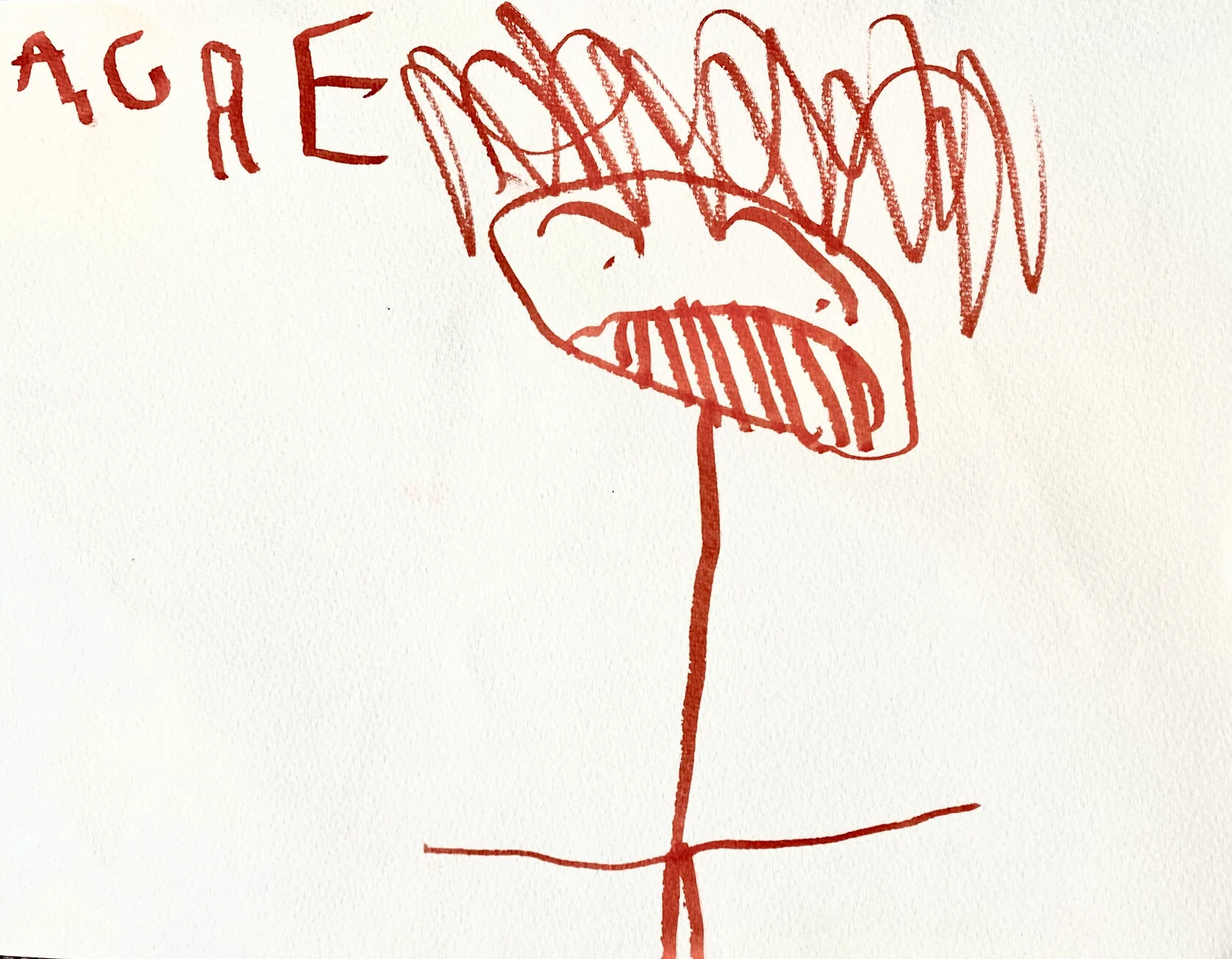
Organizing old boxes, I came upon a stack of drawings by my son when he was four. They were self-portraits in red-marker, with bold lines and giant gritted teeth; the outstretched figures were labeled “AGRE” (a sounded-out approximation of angry). Seeing them, I remembered the stage of the prolific “AGRE” drawings, found scattered around the house, produced by a kid that by all measures seemed happy and at peace with life. As a mother, all of this bold anger was daunting. “What is wrong with my kid?” I wondered. Over time the “AGRE” drawings stopped and my worry subsided.
Connecting with my Inner Four-year Old
A few weeks after finding the old drawings, I was having an “off day”. Frustrated at a number of things and generally destabilized by the national climate and pandemic, my resilience felt low and my fuse was short. Snappy and off-kilter to start, one small incident with a faulty product and I swirled into an emotional whirlpool. My pre-frontal cortex, that part of the brain tied to reason (aka your inner Jiminy Cricket) tried to put the problem in perspective. I knew this was a little thing, but that wasn’t helping. Direly needing self-regulation, I stalked off to be alone. Closing my office door, I saw a stack of paper and a cup of markers. Remembering my son’s drawings more than a decade ago, I immersed myself in my very own “ANGRY” drawing.
Self-Awareness- Curiosity and Acceptance
As I drew, I thought about how I was feeling. Anger was one part of it, but behind the anger was my need for stability, control, and normalcy. I tapped into the “off feeling”. As I drew, I realized that by giving my feelings a name and shape, I was able to understand them better. I smiled as I added colors to the page, now having a little fun. I felt more in control. I was calmer.
EI starts with knowing how you are feeling. Putting emotions onto the page allowed me to claim them.
To know how you are really feeling, to get beyond that background “off” sense, you don’t have to get out markers, but you do have to tap into your feelings and explore them. Leave the self-judgement behind. When you approach your feelings with curiosity and acceptance, they become helpful data.


The Guy on the Forklift
The guy unloading the large delivery to our driveway was clearly skilled with the forklift. I watched him, remembering how when my boys were little they looked upon the guys maneuvering equipment with awe. Heros.
Carefully setting down the pallet, he jumped out of the cab and approached me. Now, if you know me you know I ask a lot of questions. "So, are you incentivized for less damage or quicker delivery?" I asked with a smile. "Actually, neither, and it is a PROBLEM," he answered.
The guy unloading the large delivery to our driveway was clearly skilled with the forklift. I watched him, remembering how when my boys were little they looked upon the guys maneuvering equipment with awe.
Carefully setting down the pallet, he jumped out of the cab and approached me. Now, if you know me you know I ask a lot of questions. "So, are you incentivized for less damage or quicker delivery?" I asked with a smile. "Actually, neither, and it is a PROBLEM," he answered.
Turns out he is also the guy scheduling deliveries and managing truck repairs. And dealing with employee churn for the company. He and his employer have different views about managing people, and this has been more than a bit challenging.
We started chatting. He and his wife recently moved from another state. He was just finalizing the sale of his lube business back home, and now could help his wife with her dream of being a salon owner. Shaking his head, he mentioned his management style is very different than his current boss. I asked him again about incentives. He painted a picture of how he did it:
“My guys knew we were all in it together. I opened my books to them, and when we did better, they took some of it home. I supported four full time employees who felt proud about what they could contribute. When you include employees in the decisions, everyone has the ability to grow together."
I asked if he read Jack Stack's book, "The Great Game of Business", a twenty-year old open-book classic which admittedly reads like “pop business”. He hadn't read it. I was astonished- the guy could have written it. Through truly valuing his people he figured out what worked on his own. He respected his guys enough to open his books and ask them, “How can we do this better?”
Stack sees power transparency in numbers. He has seen how it can change the way a person looks at their job. He writes about showing the parts guy in his warehouse how he was not just a cog in the wheel by educating him in the numbers. When the assembly line went down due to a delay with a part, he could see and understand the impact. “Suddenly what he does has meaning. It’s not work; it’s not just a job; it’s a responsibility. And it’s food on his family’s table,” he writes.
Stack also writes about sharing equity, or giving your employees “skin in the game”. My delivery friend was clearly proud to have shared the good times with his small crew. I got to thinking, what mindset, and what values, lead a business owner to share the wealth?
You inherently believe that your people have something to offer, no matter what their job description
You value honesty and honest work
You care about other people’s well being
You value family
The guy he was now working for, on the other hand, "rules with an iron fist". My new friend painted a picture of pressure, damage to equipment, and high employee churn.
Clearly the owner doesn’t believe his people have something to offer. Sadly, he doesn't realize the tremendous asset he has driving his forklift, the guy I was now looking at like my kids would have, with awe. In this day, when it is easy to make the wrong choice, he did the right things.